


The State Board of Education voted unanimously at its March 26 meeting to advance the standards to the Legislature. Academic standards are guidelines of topics teachers must teach, but they are not curriculum. Districts have the sole authority to decide which instructional materials will be used in the classroom.
During discussion, State Superintendent Lindel Fields and members referenced board “working groups” that met after the standards’ public comment period.
According to reporting from Oklahoma Voice, Fields said there were “minor changes” made to the approved draft, which was publicly posted 24 hours before the meeting without the alterations highlighted.
“You’ll see some changes, but none that will surprise you,” Fields said.
The department declined a request to interview Fields, saying it had “answered a significant number of questions for [StateImpact] on this topic.”
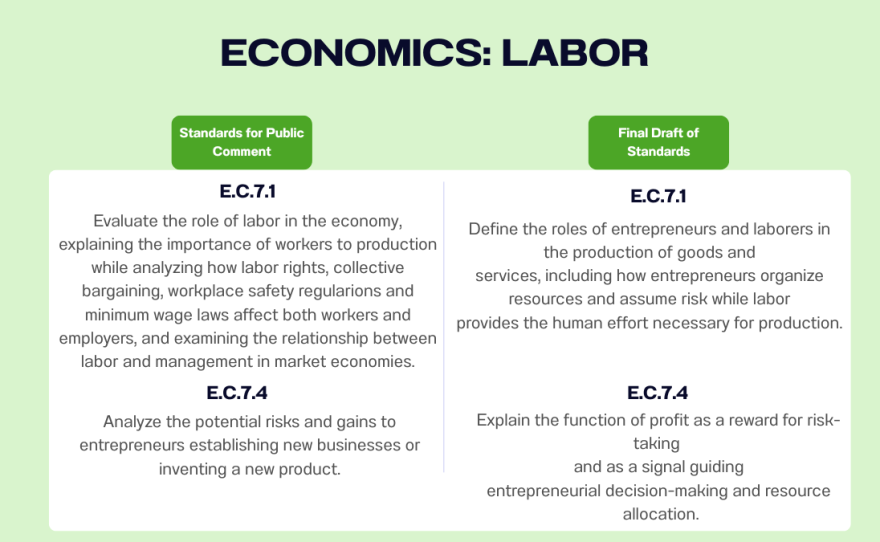
An analysis by StateImpact found at least 40 changes in the final draft.
In the final draft, some standards are rewritten, and some are entirely new. For example, a pre-public comment standard for fourth-grade social studies asks students to “explain how Tribal Nations possess an inherent right to self-govern (sovereignty), which includes the authority of Tribal governments to establish and enforce laws, as well as manage their land’s resources.”
The revised standard does not include the definition of tribal sovereignty: “Analyze the historical development of American Indian Citizenship and constitutional rights in the United States of America. Examine how tribal sovereignty and United States of America citizenship function within the United States of America.”
New standards include ones such as this U.S. Government standard: “Analyze the influence of certain Biblical texts on founding documents such as the Constitution and the Declaration of Independence.”


Like the 2025 standards under former Superintendent Ryan Walters, the revised set also includes two new courses: Ancient and Medieval World History and History of 20th Century Totalitarianism.
The standards for the totalitarianism course between the Walters’ 2025 version and the 2026 version are identical, and the standards of the Ancient and Medieval World History course are similar, but leave several items out.
A source who worked on the standards writing committee for the 2025 and 2026 standards said the two new courses’ standards were not developed by Oklahoma’s writing committee.
The approved standards also feature typographical errors.
A revised first-grade social studies standard asks students to “Compare the roles of consumers and producers in the United State [sic] of America economy…”
A revised Modern World History standard asks students to “Describe the legacy of the Napoleonic Wars including an accelerated rise of nationalism across Europe, Britain’s role in maintaining a balance-of-power, and how the and how the [sic] Congress of Vienna attempted to establish a new political order in Europe.”
StateImpact attempted to reach board members for comment, but was referred to OSDE communications director Tara Thompson.
Thompson said in an email the department is aware of the “small number of typographical and scrivener-type errors.”
“Those issues do not change the substance of the standards and can be addressed through the normal correction process,” Thompson said.
Thompson said changes to the standards reflected the Board’s review of the draft, which included public comments and “other feedback” received.
“While this process may look different from prior standards cycles, it reflects a deliberate commitment by the Board to fully carry out its constitutional responsibilities,” Thompson said. “... The Board’s role is not to simply advance a draft, but to review, refine and ultimately approve standards that are academically sound.”
In an April 6 article on the conservative Oklahoma Council of Public Affairs website, author David Randall claimed the standards were informed by the American Birthright social studies standards. Randall is the research director of the National Association of Scholars, a conservative education advocacy organization.
The thrown-out 2025 standards from Walters were also rumored to be informed by the American Birthright standards, written by the National Association of Scholars’ Civics Alliance. According to its website, it seeks to counteract civics education being used as a “recruitment tool of the progressive left.”
At the time, OSDE did not respond to confirm whether American Birthright was used in the 2025 standards.
Regarding the 2026 standards, Thompson responded that David Randall was not involved in the process and American Birthright had no influence on it. David Randall could not be reached for comment.
An unusual revision process
Academic standards are revised every six years, as per state law. The standards go through several committees of educators and, in the case of social studies standards, other stakeholders such as Tribal citizens and historians.
The executive committee, writing committee and draft review committee all have hands in revising the standards. According to OSDE, the executive committee works with the department subject area directors to guide the process. The writing committee revises standards as necessary. The draft review committee provides feedback to the writing committee.
The standards are also subject to feedback from focus groups.
Once the standards have been reviewed and revised, the draft standards are made available to the public for comment. Those comments are reviewed by the executive and writing committees, who determine whether to incorporate the feedback. According to OSDE’s website, it is at that point “a final draft is sent to the State Board of Education for approval.”
According to OSDE, the 2026 team reviewed a draft of the standards that incorporated the original writing committee’s work, input from Tribal citizens and 2025 public comment. It excluded additions from Walters’ social studies executive committee.
Walters’ executive committee featured prominent conservative figures like Dennis Prager of PragerU, David Barton of the Christian Nationalist organization Wallbuilders, and Heritage Foundation President Kevin Roberts.
The 2026 writing team, composed of Oklahoma classroom teachers, convened in January to review the draft, according to the department. Tribal citizens “served on all committees throughout the revision process,” and writers were “guided by national best-practice feedback,” including from the conservative think tank Thomas B. Fordham Institute.
OSDE’s website says the executive committee is “involved in the final draft review of the standards.” StateImpact asked if the executive committee viewed and approved the final draft of the standards after the board’s working groups. Thompson said the final revisions did not require separate approval by the executive committee. Asked for a more direct answer to the original question, Thompson responded:
“We won’t recharacterize the process using simplified yes/no descriptions that don’t reflect how academic standards are developed and approved,” Thompson said. “Input comes from multiple sources such as the executive committee, tribal nations and the general public, but the process is a linear one that culminates with the Board. It is not a back-and-forth approval process.”
A contentious year for standards revisions
Last year, highly contested social studies standards stole headlines, took up oxygen in the legislative session and were eventually thrown out due to an Open Meeting violation.
The 2025 standards, captained by former State Superintendent and conservative firebrand Ryan Walters, courted controversy from their initial debut due to significantly increased content on Christian influence and emphases on patriotism and American exceptionalism.
The temperature on the hot-button standards further increased after it was revealed that more content had been added in the hours leading up to the board’s approval vote. Some board members claimed they had no knowledge of the revisions. At the time, the board had recently undergone a personnel revision from Gov. Kevin Stitt, who ousted three members over “needless political drama” and replaced them.
Board members said they were unaware the standards they’d approved had been edited to include a point asking students to identify “discrepancies in 2020 election results.” The new members spent the next two months asking the state Legislature to return the standards to the board, complaining they were not given enough time to review the changes.
But after a closed-door meeting with Walters, legislative leadership declined to block the standards. Oklahoma law does not require the legislature to vote on the standards to approve them, but rather allows them to be tacitly approved without a vote to reject them.
After the Oklahoma Supreme Court decided in a split decision to permanently nullify the 2025 standards, the Oklahoma State Department of Education went back to the drawing board to drum up new standards.
When the remaining old-guard members of the board were replaced — and another added — and Walters resigned from his position, now-Superintendent Lindel Fields tasked himself with “steadying the ship” at the state department.
Social studies educators raise concerns about transparency
Aaron Baker teaches U.S. Government at an Oklahoma City-area high school. After reading the new standard on the influence of the Bible on founding documents, he said it strikes a familiar chord with the standards under Walters’ administration.
“It seems less charged — we saw language last year that was just waving a flag of Christian nationalism,” Baker said. “This feels like it’s flying a little bit more under the radar, but it still feels like it’s coming from the same place, to be honest.”
Baker said in his experience, there is little oversight of whether a teacher covers every standard. Rural schools, he said, have too few personnel, and larger schools cannot observe every minute of every teacher’s classroom.
Baker said he would potentially teach a standard like that in a debate format or inquiry model to allow students to come to their own conclusions.
“Allowing students to think critically and ask difficult questions, and to question even what I’m presenting as a teacher — that’s not indoctrination, that’s actually the opposite of indoctrination,” Baker said. “I teach the standards, I do my job. And I believe that I do it well.
But I don’t ask my students to hold any sort of fidelity to any sort of belief that is embedded in the standards.”
Rep. Jacob Rosecrants, D-Norman, taught middle and high school geography and history before his time in the legislature. He said unless someone is well-versed in standards or social studies, it’s difficult to explain why seemingly small changes add up.
He pointed to a revised standard for sixth-grade Western Hemisphere Geography, which asks students to describe cultural interactions between American Indian cultures and European settlers.
“That all makes sense, except this was changed to ‘American Indian cultures’ from ‘Indigenous cultures,’ which, if you’re a history person, you understand that this restricts the objective of the standard to the continental United States, which was not the intention of the educators who actually wrote the standard,” Rosecrants said.
The restriction does not help students understand that European settlement changed life in the entire Western Hemisphere, not just in America. So, do you see how hard that was to explain?”
Rosecrants said he has been “really happy” with the change in tone Fields’ administration has displayed over the Walters administration, as well as Fields’ invitation to executive sessions — an issue that made headlines after Walters denied access to Rosecrants and other lawmakers.
He said he was “heartbroken” and “angry” to see another controversy with the social studies standards under Fields’ leadership.
“I see it as a check and balance,” Rosecrants said. “I’m not comfortable with the board having any kind of say in [writing the standards] because they are another piece — just like the legislature — another piece of oversight.”
Rosecrants authored House Bill 2987, which would have stipulated that if the legislature fails to adopt the standards within 30 legislative days following the submission of the standards, the standards would be disapproved, rather than approved.
Despite bipartisan support in the House Education Oversight Committee — and a Republican Senate co-author — the measure was not heard on the House Floor.
A social studies educator from the Oklahoma City area spoke to StateImpact on condition of anonymity as they did not have clearance from their district to speak to the media. The educator was also on the writing committee for the 2025 and 2026 standards.
“The credibility of public education depends on integrity of leaders. And truth, and transparency and credibility — I just feel like it went out the window,” they said. “It just can’t be part of the process that six political appointees can get in a room and write the standards for our entire state for all of public education. That just can’t be the way that things happen in our state.”
They said they did not agree that the board has the authority to revise or edit the standards. Oklahoma law says the board may “adopt” and “approve” the standards.
They likened the situation to “a group of people who took plumbing classes at a VOTEC while in high school … [writing] the plumbing codes for new construction for the entire state of Oklahoma.”
“As far as procedural authority, I don’t think it’s there. And then, as far as just conceptual knowledge, how do you actually think that you know better than all the dozens — if not over a hundred — of educators who worked on this?
The standards are now in the hands of the legislature, which can choose to allow them to go to the governor without a vote.
StateImpact Oklahoma is a partnership of Oklahoma’s public radio stations which relies on contributions from readers and listeners to fulfill its mission of public service to Oklahoma and beyond. Donate online.


