


Oklahoma has been locked in a court battle with a handful of large poultry companies for more than two decades. But for the first few months of this year, it seemed like the lawsuit might be coming to a close.

In early March, dozens of people filed into Judge Gregory K. Frizzell's Tulsa courtroom to hear him weigh proposals to resolve the case and end most of the appeals.
Poultry professionals packed the benches hip-to-hip behind lawyers representing Tyson Foods, Cargill and Peterson Farms Inc. Across the gallery, the rest of the audience had a little more room to spread out behind the attorneys representing the state.
Despite the clear divide, people on both sides of the courtroom are eager for the case to conclude.
In fact, for the first time, the state and the poultry companies were asking the judge for the same thing. They wanted Frizzell to approve consent judgments — legally binding compromises — on how to clean up existing damage in the watershed and how to deal with poultry litter moving forward.
"The attorney general is not standing here in front of the court today telling the court that he got everything that he wanted in this settlement," said Garry Gaskins with the Oklahoma Attorney General's Office. "This is an agreement that the attorney general believes is in the best interest of the state and he got the best terms that he believed he could get in this case."
Steve Butler was one of the poultry growers in the audience. He said the terms of the settlements weren't ideal for the poultry companies either.
"I couldn't believe they gave in that much," Butler said in an interview the week after the hearing. "But these agreements were made. And they presented to him [Frizzell]. And then they play white noise. And then he gets up and says, 'Adjourned.' You don't know if he's going to wait 13 years to rule on that."
Frizzell did not — he nixed the settlements about a month later.
Now, Oklahoma poultry growers and environmental advocates alike are wondering when they'll be able to move past this, while the judge works to turn the uncertainty of the past two decades into a meaningful legal outcome.
A lifestyle and a business
Butler loves being a poultry grower.
"It's been good to us as far as a way of living, being able to work with your family," he said in an interview on March 18. "But, you know, obviously we like to make money. So it's the best way to make a good living in eastern Oklahoma on a farm."
Butler's operation, Green Country Farms, is based in Watts, Oklahoma. As a third-generation poultry producer, he has been in the watershed since before the lawsuit was filed.
The defendants in the lawsuit are poultry integrators — the large companies that own the birds and coordinate their lives, deaths, processing and distribution. The largest still operating in the Illinois River Watershed are Tyson Foods, Simmons Foods and Cobb-Vantress Inc., which is owned by Tyson.
But the people who actually deal with the chickens are poultry growers, like Butler.

A grower's business is to care for the birds, feed them and deal with their waste. The growers are not technically involved in the lawsuit.
"We never sued farmers," said Drew Edmondson in an interview on March 31. "The poultry companies tried to bring farmers in as third-party defendants. And we opposed it. And the judge denied it."
But Butler said growers have never been insulated from the lawsuit. He said in the mid-2000s, helicopters flew over poultry operations to take photos, and unmarked police cars were often in the area.
"The folks around here got pretty mad," he said. "They don't like being spied on. But then it became a real nuisance when we'd have to do depositions…. I had to spend the entire hours that they were allowed in depositions. We had to have lawyers representing us when we weren't a party to the suit."
Now, the effects on growers are more about economic uncertainty.
Butler said it's particularly difficult because his company exports all its litter out of the Illinois River Watershed. He's spent decades building a customer base of farmers, many in Kansas, who will buy his litter to use on their land.
He's also been part of the non-profit Illinois River Watershed Partnership.
"We all got along and worked together to try to improve the Illinois River," Butler said. "But then in the meantime, I'm sitting here wondering if I will get to stay in business, and so it's frustrating that way."


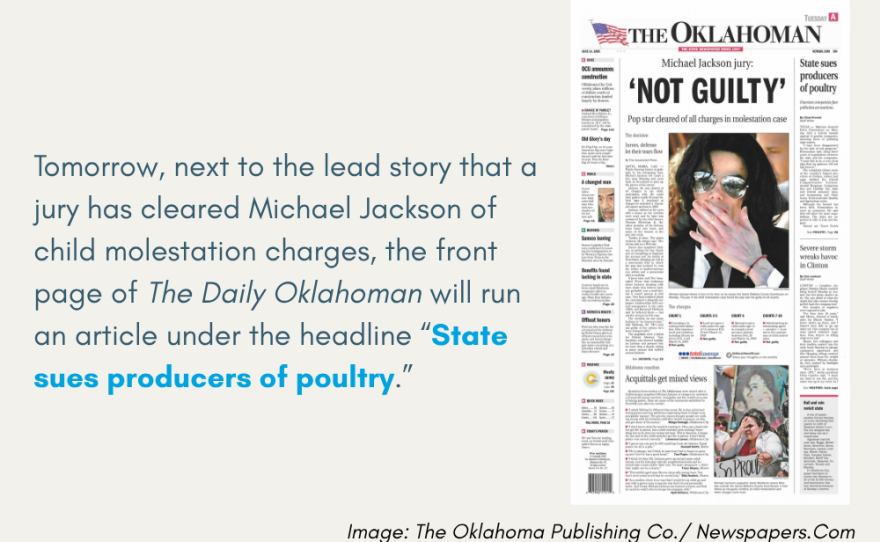

Tyson in particular has been clear about its intention to stop contracting growers in the Illinois River Watershed. Before Frizzell rejected the settlement agreements, Tyson announced that it would not renew contracts with growers in the watershed unless and until the settlement went through.
In documents obtained by KOSU, the company sent letters to at least two Northwest Arkansas growers, saying it would not renew their contracts unless the settlement was approved.
With contracts for nearly 7 million birds in the four counties containing the Illinois River Watershed, Tyson is the second largest integrator there. The largest is Simmons, which did not put forward a settlement agreement with the state.
Both companies have been contracting fewer birds in the IRW since Frizzell released his ruling in 2023 than they were before, according to data from the Oklahoma Department of Agriculture, Food and Forestry.
Butler said he's grateful to Tyson for staying in the watershed at all.
"Much like other companies have done, they could have just left, said, 'We're done,'" Butler said. "But they've stayed here and tried to do business. I respect that. Are they a big mean company? Yeah. But the bottom line is: They are trying to do business right here."
Crystal clear waters
But as business goes on, the watershed and the people who love it are also stuck in limbo.
"We have lost 20 years of being able to remediate the damage caused by 60 years of land application of chicken litter throughout the watershed," said retired attorney Gerald Hilsher.
Hilsher served on Gov. Frank Keating's Animal Waste and Water Quality Protection task force starting in 1997 and on Oklahoma's Scenic River Commission after that.
But his love for the Illinois River and Lake Tenkiller started long before, when he was a student at Northeastern State University in Tahlequah.
"Back in 1974 to '76, when I was a student there, Lake Tenkiller was a strikingly clear lake," he said. "It was a place where scuba divers loved to go because they could see 15, 20, 30 feet underwater and because the lake was so clear. When I returned to Oklahoma after law school in 1979, you could already see the effects of phosphorus pollution on Lake Tenkiller."

Hilsher said phosphorus pollution and the resulting algae growth left 60-80% of the lake without oxygen, "basically dead."
Scuba divers still go to Lake Tenkiller, and hundreds of thousands of people still float the Illinois River each year. He said the people living on top of the watershed are feeling the impact of pollution.
"The businesses like your canoe operator, the recreational and touristry business, and also your municipal or county wide water treatment plants that have to deal with the expanding load of water treatment to supply potable water to their communities,"Hilsher said.
Statewide, tourism generates about twice as much economic activity as the poultry industry. Both industries are particularly concentrated in the Illinois River Watershed.
Alongside the concern that the poultry industry could move out of the watershed, there's worry that tourism isn't what it could be, and that it will decline if river conditions don't improve.
Time has not stood still in the watershed. Conservation efforts across state lines, including trucking litter out of the watershed and soil sampling, have softened the poultry industry's impact on the area. But Hilsher said the watershed still needs work.

"It is true that a lot has been done," Hilsher said. "But the fact remains that we have destroyed Lake Tenkiller. We had degraded the Illinois River and Barren Creek and down in Lake Wister.".
But he said he understands why Frizzell took his time on a ruling, and why he didn't approve settlement agreements more lenient than his final order.
"Part of me says, 'Gee whiz, it's been way too long,'" Hilsher said. "And on the other hand, I say, 'Well, this has taken a lot of time and effort and I've just got to trust Judge Frizzell that he has moved it along as quickly as he could.'"
In his rejection of the settlements, Frizzell wrote the integrators rolled the dice rather than settling earlier, in hopes they'd receive favorable judgment. Hilsher said the "dice rolling" isn't an approach he's seen in his 45 years as an appellate lawyer.
"This is a very curious lawsuit. It doesn't look like anything I've ever been a part of or experienced," Hilsher said.
Politics at play
Edmondson brought the state's lawsuit against the poultry integrators when he was Oklahoma Attorney General.
Since his term ended in 2011, the lawsuit has been in the hands of six different acting attorneys general, although none of them have had much to do on it until current Attorney General Gentner Drummond.
Butler has his suspicions about the 13-year pause between the courtroom arguments and Frizzell's ruling.
"We always wondered why nothing happened," he said. "But then 13 years later, three days after the attorney general [Drummond] takes office, the judge rules."
Edmondson also thinks the timing may have been calculated.
"Several of those predecessors especially — and I will mention Scott Pruitt — if the judge had ruled during his term, I don't think it would have been pursued," Edmondson said. "I think they would have reached a sweetheart deal and deep-sixed it. That's what I believe."
Drummond's term as attorney ends next year and while working on the case, he is running for governor.
In a hearing on February 27 to discuss the proposed settlement with George's, Inc, Frizzell asked Drummond if political pressure was influencing his handling of the case. Earlier, the case cost Drummond an endorsement from the Oklahoma Cattlemen's Association.
"I do respond to political reality," Drummond said "I have 10 months left in my tenure and no guarantee to be governor. And when my tenure is up, and if I'm not governor, then you can anticipate this case is dismissed. And there is no remedy to the State of Oklahoma."
Although there are other settled cases concerning excess phosphorus and water, Edmondson said State of Oklahoma v. Tyson Foods sets a precedent, providing other states a template of what is achievable.
Throughout the consideration of the consent judgments, Frizzell's final order from December has remained in place. The poultry companies will continue to appeal his order and his denial of the settlements. The 10th Circuit Court of Appeals in Denver could consider the case.

Edmondson said, though, it's unlikely an attorney general could dismiss the case now that Frizzell has issued a ruling.
"We don't know what's going to happen once he [Drummond] leaves the office," Edmondson said. "But we're in better shape on that than we were before the judge ruled, I think almost certainly."
Butler said his ideal scenario would have been for Frizzell to approve the settlements — Tyson's requirement for renewing grower contracts in the watershed.
"I don't see a positive outcome other than him approving that," Butler said. "So we don't have a real good outlook right now."
Hilsher also sees a long road ahead.
"I wish I could be more optimistic than I am," Hilsher said. "I'm concerned that we're going to spend another three to five years waiting for a final decision from the Court of Appeals, which may then either go to the Supreme Court and have more delay."
This report was produced by the Oklahoma Public Media Exchange, a collaboration of public media organizations. Help support collaborative journalism by donating at the link at the top of this webpage.


